



Why willing households still struggle to take climate action
Many households want to reduce their carbon footprint but face barriers that limit their ability to act. Five propositions show how policy can close the gap between willingness and action.
ByNicky Morrison

18 November 2026
COP31 brings renewed attention to a persistent challenge: the gap between climate commitments and the changes needed to deliver them.
Governments have invested considerable effort in encouraging households to make lower-carbon choices, from heating and cooling their homes to the cars they drive and the goods they consume. Information campaigns, financial incentives and behavioural interventions all have a role to play.
But encouraging change is not the same as enabling it. Climate policy needs to consider whether people have the practical means and opportunities to act, and whether the policies, institutions and systems around them support lasting change.
Households face very different barriers, from a lack of control over decisions to financial constraints and uncertainty about what to do even when they have the means to act.
A renter may want to insulate their home but have little control over improvements to the property. A homeowner may be keen to install rooftop solar but struggle to afford the upfront costs, even with government incentives. Another household that could afford an electric vehicle may be overwhelmed by conflicting information about costs, charging infrastructure and available options.
These are not necessarily failures of motivation. They raise a more fundamental question: how can climate policy better connect what households are encouraged to do with what they are actually able to do?
Connecting the dimensions of household climate action
My recent paper in Sustainability reviews four complementary approaches to understanding household climate action and develops a framework for connecting them. From this, it proposes five testable propositions to guide more effective policy.
Behavioural approaches examine motivation, knowledge, habits and decision-making. Social approaches consider how people influence one another and how practices become established or change. Structural approaches focus on affordability, tenure, infrastructure and access. Systems approaches examine how housing, energy, transport and other services are organised and provided.
The framework explores how these different influences may support one another, create barriers or undermine intended outcomes. It helps identify where policy interventions might need to work together, rather than treating household decisions in isolation. It also considers the role of governance and implementation: who has responsibility, which policy instruments are available and how interventions are delivered.
Figure 1 — A layered framework for household demand-side climate mitigation.
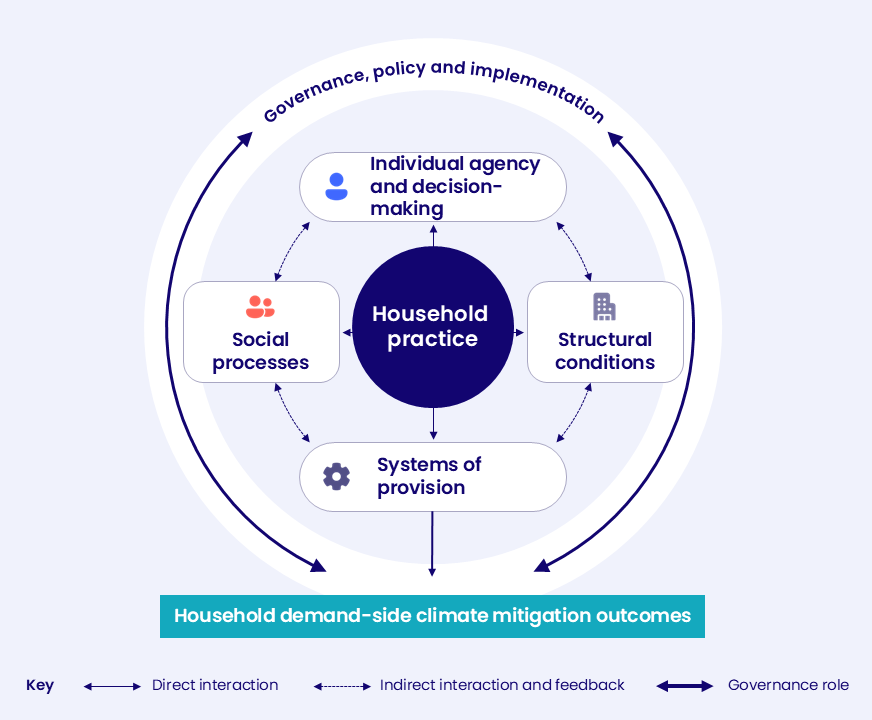
Adapted from Morrison (2026).
For policymakers, this provides a way to examine why interventions may succeed, fall short or produce unequal outcomes, and where complementary action could improve their effectiveness. For researchers, it offers a structure for testing these relationships and strengthening the evidence on what works, for whom and under what conditions.
When policy interventions meet real-world constraints
Whether governments use incentives, regulation or information to encourage household climate action, their effectiveness depends on more than the policy instrument itself. Individual choices are shaped by social influences, structural opportunities and wider systems of provision.
APPI-funded research led by the Urban Transformations Research Centre's (UTRC) Dr Tom Longden, of which I was a co-investigator, illustrates this by examining the challenges of making apartment buildings EV-ready.
An apartment resident may be willing and financially able to purchase an electric vehicle, yet access to charging can depend on building infrastructure, owners corporation decisions, installation costs and arrangements for shared spaces.
A purchase incentive cannot, on its own, resolve these issues. Nor would providing more information necessarily overcome them. The policy challenge is to identify which conditions are critical to making an intervention effective, and how they can be connected in practice.
Five propositions for more effective climate policy
The published paper develops five testable propositions that build on the four perspectives, moving from household capacity and social influence to the alignment of enabling conditions, longer-term outcomes and governance. These are not established causal findings, but offer a basis for improving policy design, implementation and evaluation.
- Motivation alone does not determine whether households can act.
Willingness to act translates into change only where households have sufficient opportunity and capacity. A rebate may be attractive to households with savings and control over their homes yet remain inaccessible to others. Policy effectiveness therefore needs to be assessed not only through uptake, but through who can participate, who is excluded and whether interventions reduce or reinforce inequalities.
- Social influence can accelerate change - or reinforce existing habits.
Social networks, norms and trusted relationships can strengthen or weaken responses to climate interventions. Seeing neighbours, for example, install solar panels or purchase an electric vehicle, and hearing about their experiences, can build confidence. This “I will if you will” effect can help new practices spread, while seeing others stick to familiar habits may discourage change. Policy design can build on these social influences by working with trusted intermediaries and supporting the spread of lower-carbon practices across communities, rather than relying on information campaigns alone.
- Interventions are more effective when the conditions needed for change work together.
Household climate interventions are more likely to succeed when the right support and delivery arrangements work together. A home energy rebate, for example, may generate considerable interest but achieve limited results if approval processes are too complicated or qualified installers are unavailable. Effective policy design therefore means looking beyond the rebate itself to ensure that households can access the support needed to act. The aim is not to address every possible barrier, but to identify and tackle those most likely to prevent the intended change.
- Initial uptake does not guarantee lasting emissions reductions.
The effects of household climate interventions can change over time as practices, markets and social expectations evolve. Growing adoption of a technology may encourage others to follow, while increased energy consumption may offset some expected savings. Policy evaluation should therefore track sustained changes in household practices and emissions, rather than installations or participation alone.
- Governance arrangements influence whether interventions deliver their intended results.
Even well-designed interventions can falter when responsibilities are fragmented across organisations and levels of authority. Delays in approvals, unclear responsibilities or gaps between complementary programs can undermine delivery. Effective policy implementation requires clarity over who controls decisions, how responsibilities connect and how interventions can adapt to different places and communities.
From climate ambition to household emissions reductions
The challenge is not to choose between behavioural incentives and structural reform, nor to insist that every intervention address every dimension of household climate action.
It is to understand which relationships matter for a particular practice, how they shape the effectiveness and fairness of interventions, and how this knowledge can improve policy design, delivery and evaluation.
The five propositions provide a basis for testing these relationships across different household activities, communities and institutional settings, in Australia and internationally. Ultimately, the success of policies encouraging household climate action cannot be judged solely by rebates offered, technologies installed or people reached.
COP31 is a reminder that climate commitments must translate into meaningful action across the economy. Households have an important part to play, but the test is not simply whether governments encourage them to make lower-carbon choices. It is whether policies enable those choices and deliver measurable, equitable and lasting emissions reductions.
Nicky Morrison is Professor of Planning and Co-Director of the Urban Transformations Research Centre at Western Sydney University. Her research focuses on urban governance, climate adaptation, infrastructure funding and the implementation of more equitable and sustainable urban policy.
Image credit: Canva
Features
Jack Wilson, Emily Stockings, and Maree Teesson
Jack Wilson, Emily Stockings, and Maree Teesson
Jack Wilson, Emily Stockings, and Maree Teesson
Explore more articles


Subscribe to The Policymaker
Explore more articles
Subscribe to The Policymaker